The Sun is over a million times bigger than the Earth! But it is so far from our planet that it looks small in the sky. Even at that great distance, the Sun influences us in myriad ways. Space Weather Explorers Week is a collection of lessons and activities about the Sun-Earth connection. Several times each year you can interact with NASA scientists and ask them questions. Our next 2025 live week will be April 21 – 25. Ask questions of scientists on Discord.
The Carruthers Geocorona Observatory mission will launch on a SpaceX Falcon 9 rocket from NASA’s Kennedy Space Center in Cape Canaveral, Florida. It will launch with NASA’s IMAP mission, and NOAA’s SWFO-L1 observatory. This is called a rideshare launch where multiple missions share the same rocket to leave Earth before continuting to their final destinations.
Carruthers Geocorona Observatory Mission
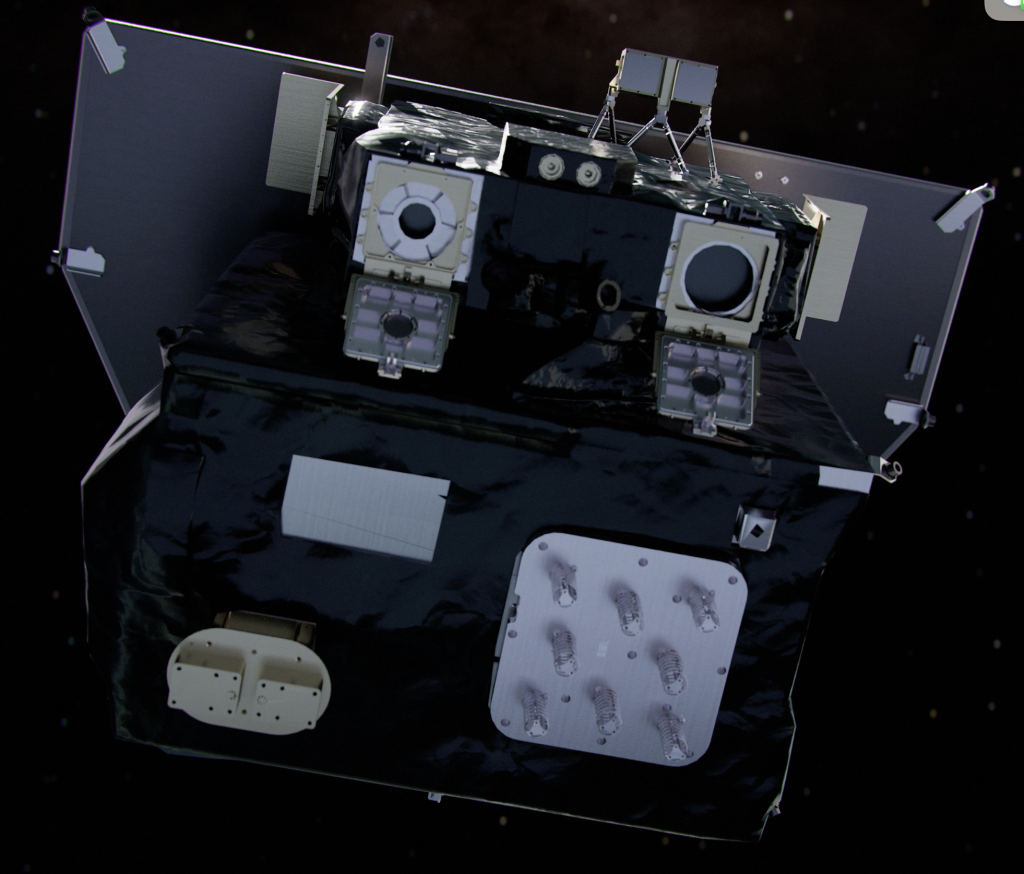
The Carruthers Geocorona Observatory will study how the outermost layer of Earth’s atmosphere changes over time an interacts with the Sun.
The exosphere is the outermost layer of Earth’s atmosphere and the geocorona is its UV glow. The Carruthers mission will continuously image the UV glow of the geocorona from deep space for years.
Scientists will use this data to investigate how the exosphere reacts to solar storms and how it slowly looses water molecules into outer space.
Can you block UV light? Follow along as we explore how everyday objects block or let UV light through.
Space weather explorers: Carruthers launching soon
The Carruthers Geocorona Observatory is scheduled to launch in September 2025 to study the outermost layer of Earth’s atmosphere, called the exosphere—or geocorona. This mission will explore how the exosphere changes over time and how it interacts with the Sun, helping NASA deepen our understanding of Earth’s space environment.
So far, scientists have captured only four images of the exosphere. The very first came in 1972, when a telescope placed on the Moon during the Apollo 16 mission observed Earth in ultraviolet light. That telescope, built by Dr. George Carruthers, revealed our planet’s faint ultraviolet halo for the first time. The new mission honors his legacy by studying the geocorona in more detail than ever before.
Meet Dr. Lara Waldrop, Principal Investigator of NASA’s upcoming Carruthers Geocorona Observatory mission, launching this September into deep space to study Earth’s atmospheric edge. Her story begins with stargazing as a teen in Japan and leads to directing a groundbreaking space science mission to study Earth’s geocorona — the outermost layer of Earth’s atmosphere.
The outermost layer of Earth’s atmosphere is called its exosphere, or sometimes the geocorona. So far, there have only ever been four images taken of the exosphere. The first image was from a telescope placed on the Moon during the Apollo 16 mission in 1972. The telescope was built by Dr. George Carruthers to observe Earth in ultraviolet light. As part of NASA’s efforts to better understand the Earth, its space environment and its interactions with the Sun, a new mission is under development. Set for launch into space in 2025, the Carruthers Geocorona Observatory will study Earth’s exosphere and how it changes over time.